
Two weeks ago, we dropped an HTTP/2 bomb cooked up by Codex Cyber. This time, we sent Claude Mythos Preview spelunking through Squid’s guts, and it surfaced clutching a 29-year-old bug.
Meet Squidbleed: a Heartbleed-style vulnerability that leaks internal memory from every version of Squid Proxy, in its default configuration.

This bug is a whirlwind tour of old-school Internet lore. It involves FTP, NetWare, and DJB, names that only the most diehard Internet fans will recognize.
It comes down to a few of C's favorite footguns: null-terminated strings, pointer arithmetic, and a weird strchr edge case. Mix these ingredients into an open-source web proxy, and you get a heap buffer overread that quietly leaks random users' HTTP requests, despite three decades of releases, audits, and rewrites.
One caveat: the impact is situational. Most traffic is HTTPS, which the proxy relays as an opaque CONNECT tunnel, so only cleartext HTTP and TLS-terminating setups are exposed. The proxy must also be allowed to reach an attacker-controlled FTP server (TCP port 21).
A tip of the hat to Anthropic, our partner-in-crime on the quest to make open-source software a little more secure.
The Target: Squid Proxy
Squid is a widely deployed multipurpose web proxy. While it was designed to speed up page loads by caching frequently accessed content, it can also be used for traffic interception, monitoring, and filtering.
Thus, Squid is often found in multi-user environments such as schools or corporate networks. In fact, I encountered Squid while attempting to access the Internet on a recent flight:
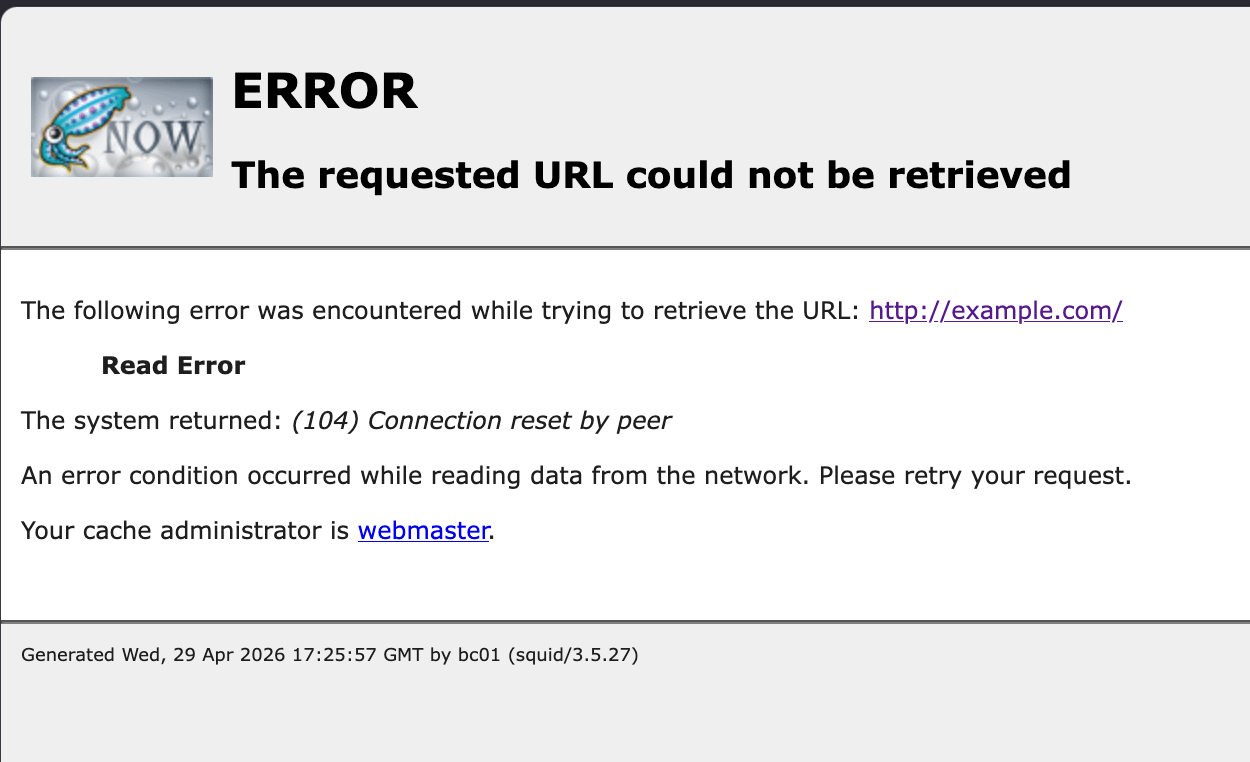
As you might expect, the version of Squid deployed on that plane was released nearly 10 years ago and is affected by the vulnerability I'm about to share with you.
FTP: Finicky To Parse
While HTTP forms the majority of web traffic, Squid also supports FTP (File Transfer Protocol, a legacy protocol for moving files between machines) by default.
When connecting to an FTP server via Squid, a nice HTML file listing is helpfully generated:
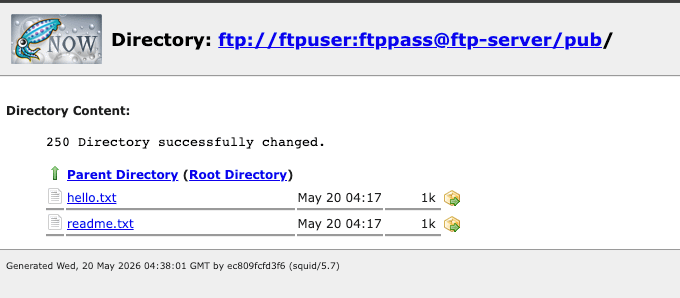
Unfortunately for Squid, FTP doesn't have a standardized machine-readable file listing format. Instead, the FTP LIST command typically returns something that sort of looks like the output from ls -l:
-rw-r--r--    1 1000     1000           40 May 20 04:17 hello.txt
-rw-r--r--    1 1000     1000           21 May 20 04:17 readme.txt
This poorly-specified textual format is notoriously hard to parse, especially while staying compatible with every FTP server on the Internet. One of our Internet heroes, DJB, wrote about it too, calling the format hard to parse with even moderate reliability. And when DJB says something is hard, you know it really is.
It is thus no surprise that when I asked Claude Mythos Preview to:
Spawn more agents to investigate the full [FTP] state machine behavior better
one of the first bugs it found was in Squid's FTP directory listing parser.
Searching for NULL
The bug predates all available commit history in Squid's GitHub repo.
Commit bb97dd37a, created on Jan 18, 1997, includes the following changelog entry:
Fixed ftpget to recognize 'NetWare' servers and skip whitespace before filenames.
NetWare was a network operating system, wildly popular in the late 80s and 90s for running corporate file and print servers, and its bundled FTP service was a common way to move files on and off those machines.
This was necessary as NetWare FTP servers output 4 spaces between the modification timestamp and the filename:
d [R----F--] supervisor            512       Jan 16 18:53    login
- [R----F--] rhesus             214059       Oct 20 15:27    cx.exe
This was contrary to the behavior of most other FTP servers, which used just a single space.
With that historical context in mind, let's have a look at the modern implementation of that fix, nearly 30 years on:
// from compat/compat_shared.h
#define w_space     " \t\n\r"


copyFrom = buf + tokens[i + 2].pos + strlen(tokens[i + 2].token);
if (flags.skip_whitespace) {
    while (strchr(w_space, *copyFrom))
        ++copyFrom;
} else {
    /* Handle the following four formats:
        * "MMM DD  YYYY Name"
        * "MMM DD  YYYYName"
        * "MMM DD YYYY  Name"
        * "MMM DD YYYY Name"
        * Assuming a single space between date and filename
        * suggested by:  Nathan.Bailey@cc.monash.edu.au and
        * Mike Battersby <mike@starbug.bofh.asn.au> */
    if (strchr(w_space, *copyFrom))
        ++copyFrom;
}
p->name = xstrdup(copyFrom);
After parsing the timestamp, copyFrom points to the first byte after it. If the FTP server's banner contains "NetWare", flags.skip_whitespace is set, and the while(strchr(w_space, *copyFrom)) loop skips past the extra whitespace.
Once copyFrom lands on the first non-whitespace byte, xstrdup copies it out as the filename. Looks correct, right?

It seemed like the perfect application of the C pointer arithmetic they teach in school.
But Claude Mythos Preview thought otherwise.
Confirmed. strchr(w_space, '\0') returns non-NULL per C11 §7.24.5.2 (terminating NUL is part of the string). This is a real bug.
The bug occurs when no filename is provided after the modification timestamp. Here's such an example:
d [R----F--] supervisor 512 Jan 16 18:53In that case, *copyFrom is the null terminator at the end of the string.
However, instead of returning NULL and breaking out of the loop, strchr returns a pointer to the null terminator, as it is considered part of the string.
This causes ++copyFrom to be executed and the cycle repeats until a non-null, non-whitespace byte is reached.

This results in a heap overread that is caught by ASAN:
heap-buffer-overflow ... READ of size 4065 ... 0 bytes after 4096-byte region
  #1 xstrdup
  #2 Ftp::Gateway::htmlifyListEntry
The copyFrom pointer thus ends up pointing to a byte outside the FTP directory listing buffer.
The data starting from that byte, possibly belonging to another Squid Proxy user, is then returned to the attacker as the name of a file in the directory listing.
Since FTP support is enabled out of the box, and port 21 is included in the default Safe_ports ACL, no special flags or non-default settings are needed. The attacker only needs to control an FTP server reachable from the proxy.
Bleeding HTTP Headers
Now that we have a heap overread, what can we actually leak?
The obvious target is HTTP requests, the most common form of web traffic and one that often contains passwords or API keys.
Squid maintains per-size freelists on top of malloc. When a buffer is freed, it is pushed onto the pool's freelist rather than returned to the system allocator. The next allocation of the same type pops from that freelist, and because the pool does not zero recycled buffers, the old contents survive intact.
The line buffer used to parse FTP listings is allocated from MEM_4K_BUF. If that buffer previously held a victim's HTTP request, only the first few dozen bytes are overwritten by the short FTP line — the rest of the 4KB buffer still contains the victim's stale data. The strchr overread walks right past the null terminator and sends it all to the attacker.
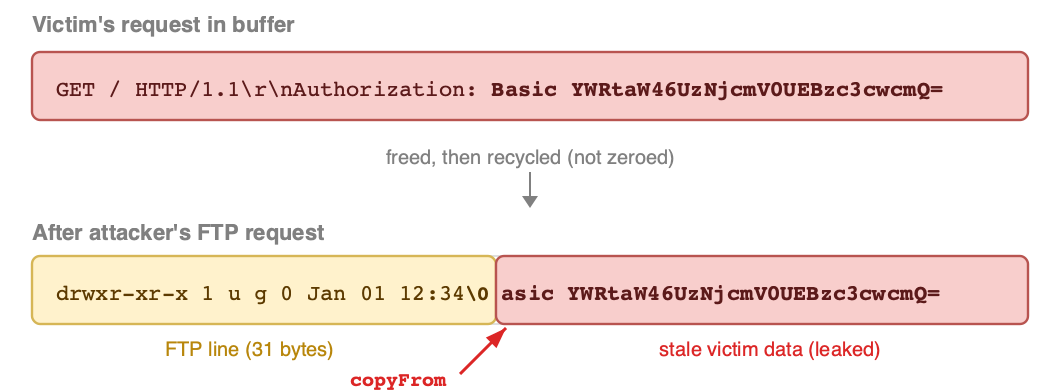
For this to work, the victim's data must pass through MEM_4K_BUF at some point. On Squid 7.x, that is easy: CLIENT_REQ_BUF_SZ is set to 4096, and is allocated with memAllocBuf, which draws from MEM_4K_BUF. Therefore, most HTTP requests (except those larger than 4KB) will be stored in a MEM_4K_BUF.
However, prior to Squid 7.x, incoming HTTP requests were allocated using memAllocString, which uses the separate "4KB Strings" pool. This is the case on our Debian test setup, as Debian distributes Squid 5.7.
Hope is not all lost though, as Squid copies the outgoing request into a MemBuf before forwarding it upstream. While MEM_2K_BUF is used by default, requests exceeding 2KB are promoted to MEM_4K_BUF. Once that buffer is freed, the attacker can reclaim it by spraying FTP directory listing requests.
To demonstrate the attack, I set up a simple login page for a web app and showed that the Authorization header can be leaked by an attacker using the same Squid proxy as the victim:
PoCs: https://github.com/califio/publications/tree/main/MADBugs/squidbleed.
Plugging the Leak
The patch is simple: check for the null terminator before calling strchr.
     if (flags.skip_whitespace) {
-        while (strchr(w_space, *copyFrom))
+        while (*copyFrom && strchr(w_space, *copyFrom))
             ++copyFrom;
     } else {
         ...
-        if (strchr(w_space, *copyFrom))
+        if (*copyFrom && strchr(w_space, *copyFrom))
             ++copyFrom;
     }
Conclusion
The dangers of raw memory access in C are well understood, but the subtleties of standard library functions like strchr are easier to overlook. Few developers would guess that searching for '\0' succeeds, which may explain how a one-line bug survived close to 30 years of code review.
Claude Mythos Preview, having trained on the entire C standard reference, treats this quirk as just another fact. When pointed at the right code, it spotted the bug almost immediately.
As a mitigation, you really ought to disable FTP at this point unless you have a specific, unusual need for it. Chrome, and by extension all Chromium-based browsers, dropped FTP support years ago, so most organizations running Squid are getting close to zero legitimate FTP traffic. Turning it off removes this entire attack surface for free.
More broadly, this might be a good habit for OSS maintainers in general: every now and then, ask an LLM which features you can safely drop. Dead code that nobody uses is still code that can be exploited.
Though FTP parsing might not be the only place where Squid forgot to stop reading. Stay tuned for the next round.
Disclosure Timeline
Update 2026-06-25: Synced the timeline with the official advisory. Notably, Aisle was omitted from the draft advisory shared by the Squid team on 2026-06-08. The acknowledgement was subsequently added on 2026-06-12.
2026-03-04 12:41:54 UTC - Initial report by Pavel Kohout of Aisle Research
2026-04-17: Initial report by Lam Jun Rong of Calif.io
2026-04-17: Fix posted
2026-04-19: Fix merged into master/v8
2026-05-07: Independent report by Youssef Awad
2026-05-17: Fix merged into v7
2026-06-08: Squid v7.6 released
2026-06-10: This blog post released
2026-06-23: Official advisory released
The official Revision history:
https://github.com/squid-cache/squid/security/advisories/GHSA-8c37-pxjq-qwrg
Revision history:
2026-03-04 12:41:54 UTC Initial Report by Pavel Kohout of Aisle Research
2026-04-17: Initial Report by Lam Jun Rong
2026-05-07: Initial Report by Youssef Awad
2026-05-17 06:04:47 UTC patch published
Why did you leave out one? :D
Hasn't AI proof-read this article, because it says "40 May 20 04:17" in the transcript of the FTP directory listing? :)